
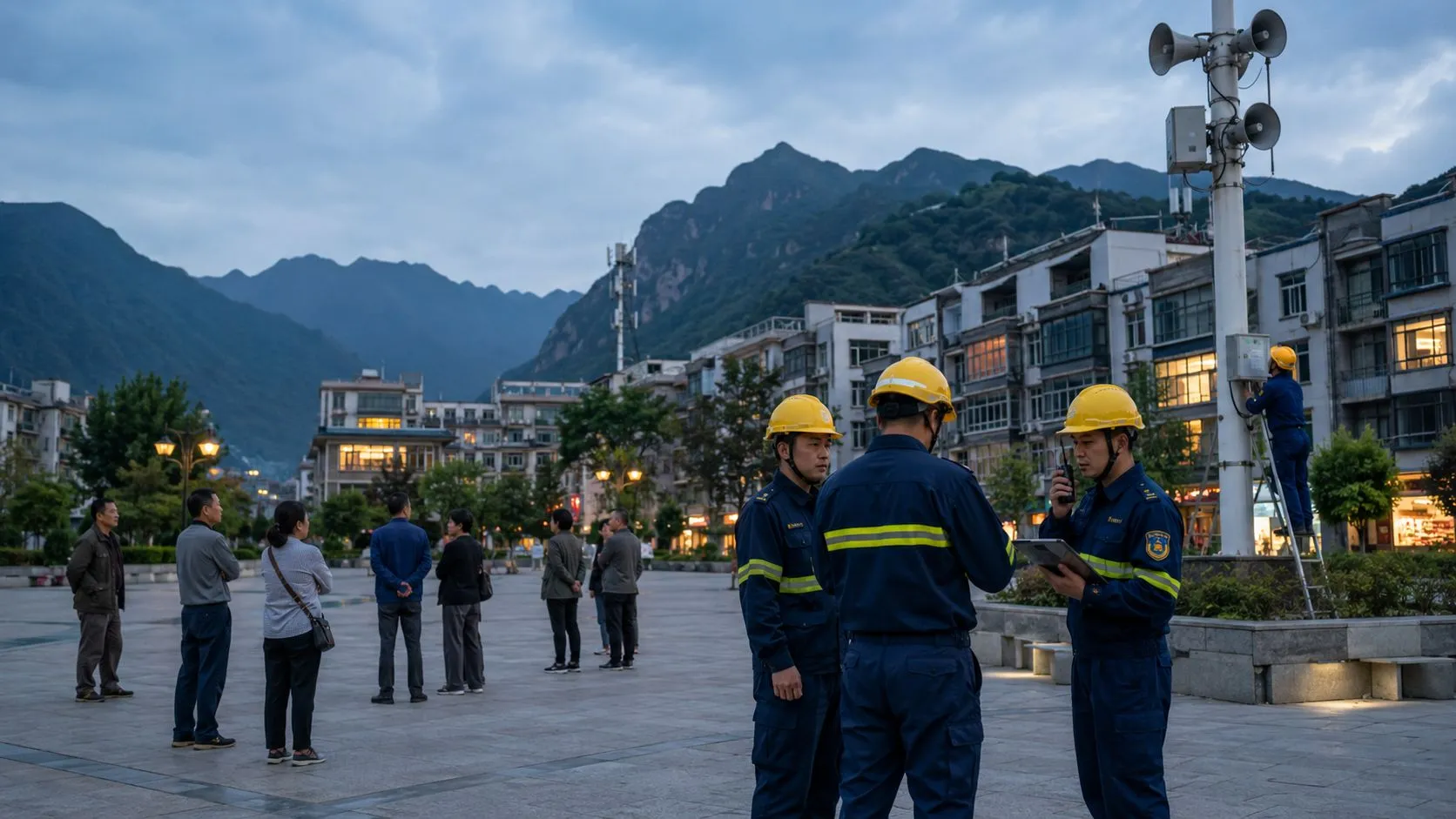
At 7:39 p.m. on September 3, a magnitude 4.8 earthquake struck Beichuan County, Sichuan Province, at a depth of 10 kilometers.
The tremor was felt across several surrounding cities, including parts of Chengdu. According to initial official reports, no casualties, road disruptions, or infrastructure damage were reported, while local power and communications remained operational.
Sichuan earthquake authorities later described the event as normal seismic activity within the aftershock zone of the 2008 Wenchuan earthquake.
Although the earthquake caused no significant damage, it offers an important reminder for the emergency-warning industry:
Earthquake warning is not simply about sending a message. It is a time-critical communication process.
Unlike weather forecasting, earthquake early warning does not predict an earthquake before it occurs. Instead, it detects seismic activity after an earthquake has already begun and can provide people farther from the epicenter with only a few seconds to take protective action.
Those seconds are valuable only when information moves quickly and reliably through the entire system:
Detection → Assessment → Warning → Protective Action → Follow-up Communication
The initial warning may tell people to protect themselves, stop machinery, or move away from hazardous equipment.
But what happens next is equally important.
Communities need verified updates. Schools, factories, transportation facilities, and public buildings need clear emergency procedures. Emergency teams need to know which areas have received the warning and whether communication channels remain operational.
This is why resilient public-warning infrastructure should integrate multiple communication channels, reliable backup power, remote monitoring, local activation, and regular system testing.
From SENKEN TECH’s perspective, the true measure of an earthquake-warning system is not simply how quickly an alert is generated.
It is whether people receive the warning, understand it, and already know what to do next.
Technology may create a few seconds of warning. Preparedness determines how those seconds are used.