
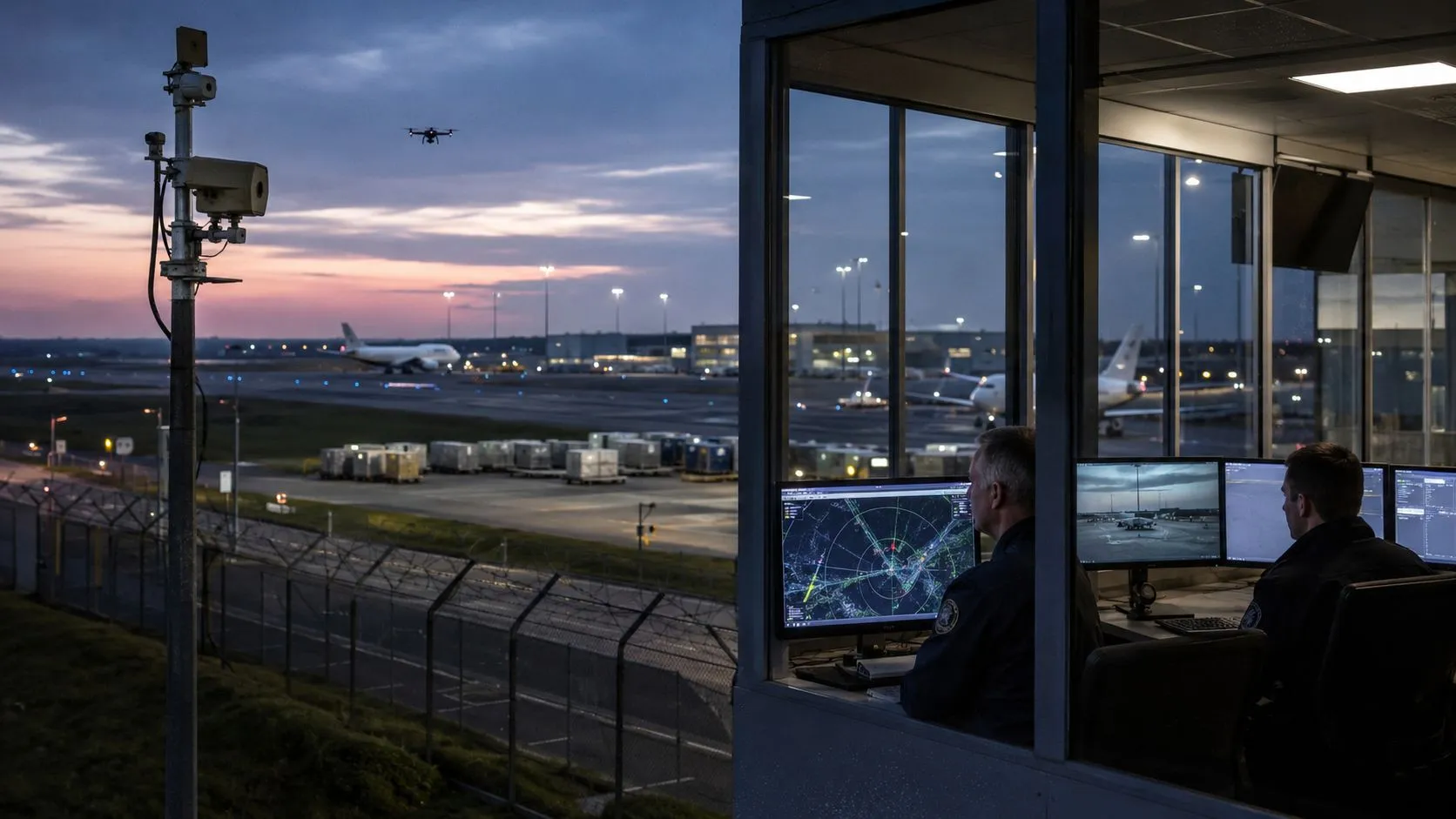
German investigators recently reported the discovery of another drone and suspected explosives near Leipzig/Halle Airport. The investigation remains ongoing, and questions regarding responsibility have yet to be resolved.
While the circumstances of the incident are still under investigation, it highlights a growing security challenge for airports, ports, energy facilities, logistics hubs and other critical infrastructure:
How can facilities detect and respond to drone threats approaching from the air?
Traditional perimeter security is primarily designed to protect the ground. Fences, access control systems, security patrols and surveillance cameras remain essential components of facility security. However, small unmanned aircraft systems (UAS) can bypass these physical barriers, approach sensitive areas from above and leave the area within a short period of time.
This creates a new dimension of low-altitude security that traditional perimeter protection alone may not be able to address.
Effective counter-UAS protection requires more than simply detecting the presence of a drone. Security teams need actionable information to understand the potential threat and determine an appropriate response.
Key questions include:
- Where is the drone?
- What direction is it moving?
- How fast is it approaching?
- Is the drone authorized?
- Which area or critical asset could be affected?
- What is the safest and most appropriate response?
For this reason, modern counter-drone security systems should be viewed as a coordinated process rather than a single detection device:
Detect → Identify → Track → Assess → Respond
Integrated Counter-UAS Protection
At SENKEN TECH, we approach low-altitude security from a system-level perspective. By integrating drone detection, sensing, optical verification, target tracking and alert management, a counter-UAS solution can provide security teams with a clearer operational picture of potential aerial threats.
Different technologies can serve different stages of the response process. Detection technologies can identify potential drone activity, while optical systems can support visual verification and tracking. Alert management and centralized control can then help security personnel coordinate the appropriate response across different areas of a facility.
This integrated approach is particularly relevant to critical infrastructure security, where unauthorized drones may create risks around airports, ports, power plants, energy facilities, industrial sites, logistics centers and other sensitive locations.
Why Early Drone Detection Matters
No single technology can eliminate every drone-related security risk.
However, early drone detection and accurate threat information can give security teams more time to verify an incident, assess its potential impact and coordinate an appropriate response.
For critical infrastructure operators, this additional time can be valuable. It can help security personnel move from simply knowing that a drone is present to understanding where it is, what it may be doing and which areas could be affected.
As drone technology continues to evolve, facility security must evolve with it.
The airspace above a facility is becoming part of its security perimeter.