
1. 110dB vs 120dB: The Basic Difference
The most important thing to understand is that decibels (dB) use a logarithmic scale, rather than a linear scale.
Therefore, an increase from 110dB to 120dB is much more significant than simply "10% louder."
For sound intensity, a 10dB increase corresponds to approximately 10 times the acoustic intensity under comparable measurement conditions.
From a human perception perspective, a 10dB increase is often described as being perceived as roughly twice as loud, although actual perceived loudness depends on frequency, tone, duration, and listening conditions.
| Specification | 110dB | 120dB |
| Acoustic intensity* | Reference | Approx. 10× |
| Typical perceived loudness | Reference | Roughly 2× |
| Potential to overcome background noise | Moderate | Higher |
| Typical applications | Smaller areas / relatively quiet environments | Industrial / outdoor / high-noise environments |
*Assuming the same measurement conditions and reference distance.
So, 120dB is not simply "10% louder" than 110dB.
2. Why Does 10dB Make Such a Big Difference?
The decibel scale is logarithmic.
The relationship between sound pressure level and sound pressure can be expressed as:
SPL = 20 × log₁₀(p / p₀)
where:
- SPL= sound pressure level in decibels
- p= measured sound pressure
- p₀= reference sound pressure
This means that relatively small changes in dB can represent substantial changes in acoustic output.
For example:
- 110dB → reference level
- 120dB → 10dB
- 130dB → another 10dB
A 120dB siren therefore has substantially more acoustic output than a 110dB siren when the two ratings are measured under equivalent conditions.
However, more acoustic output does not automatically mean 10 times the warning distance.
That distinction is extremely important when selecting an industrial siren.
3. Does a 120dB Siren Cover Twice the Distance?
No.
This is one of the most common misunderstandings when comparing sirens.
In an ideal free-field environment, sound pressure level decreases as the distance from the sound source increases. A commonly used approximation is that sound pressure level decreases by about 6dB each time the distance is doubled.
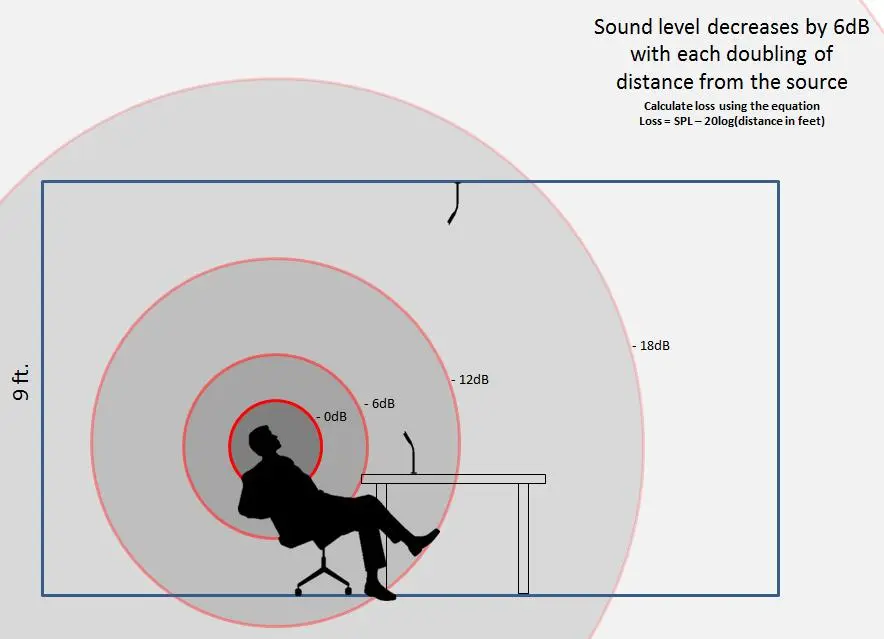
For example, if a siren produces 120dB at a specified reference distance:
| Distance | Approx. SPL* |
|
1 m |
120dB |
|
2 m |
114dB |
|
4 m |
108dB |
|
8 m |
102dB |
|
16 m |
96dB |
|
32 m |
90dB |
A 110dB siren under the same idealized conditions would be approximately:
| Distance |
Approx. SPL* |
|
1 m |
110dB |
|
2 m |
104dB |
|
4 m |
98dB |
|
8 m |
92dB |
|
16 m |
86dB |
|
32 m |
80dB |
*Illustrative free-field calculation. Actual sound levels depend on the siren, measurement method, frequency, environment, terrain, weather, obstacles, and installation.
The important point is that the 10dB difference remains meaningful as distance increases.
4. The Measurement Distance Matters
When comparing two sirens, you should never look only at the dB number.
You also need to ask:
At what distance was the sound level measured?
For example:
- 120dB @ 1m
- 120dB @ 5m
- 120dB @ 10m
These are not equivalent specifications.
A siren rated at 120dB at 1 meter cannot automatically be compared with another siren rated at 120dB at 10 meters.
This is why professional siren specifications should clearly identify the measurement conditions, including:
- Sound pressure level
- Measurement distance
- Measurement direction
- Frequency or frequency range
- Test environment
Always compare dB ratings on a like-for-like basis.
5. Background Noise Is Just as Important as Siren Output
A siren does not operate in a silent laboratory.
Industrial environments can be extremely noisy.
Typical sources of background noise include:
- Heavy machinery
- Mining equipment
- Trucks and construction vehicles
- Compressors
- Pumps
- Ventilation systems
- Manufacturing lines
- Railway operations
- Aircraft and airport operations
In these environments, a siren needs to produce a warning signal that can be clearly distinguished from the surrounding noise.
For example, a 110dB siren may be adequate for a relatively quiet outdoor location, but the same siren may provide insufficient warning in a noisy industrial facility.
6. Siren Output Is Not the Only Factor
Two sirens with the same 120dB rating may perform very differently in the field.
Why?
Because warning effectiveness depends on several factors.
1. Siren Location
Installation height and position can have a major impact on sound propagation.
A siren installed above surrounding obstacles may distribute sound more effectively than one installed behind buildings or equipment.
2. Directionality
Horn speakers and directional sirens do not necessarily produce the same sound level in every direction.
The specified SPL may represent the level measured directly in front of the siren.
The sound level at the side or behind the siren may be significantly different.
3. Buildings and Obstacles
Walls, machinery, storage tanks, buildings, trees, and other structures can block or reflect sound.
4. Terrain
Hills, valleys, and uneven terrain can affect how warning signals propagate.
5. Wind
Wind direction can influence sound propagation, particularly over larger outdoor areas. Federal Signal's installation documentation specifically identifies weather, terrain, obstacles, siren height, and wind as factors affecting sound level at distance.
6. Frequency
The frequency characteristics of the warning signal also matter.
A siren is not simply a source of "noise." Its tone, frequency, modulation and temporal pattern can influence how easily people detect and recognize the warning.
7. Final Takeaway: 110dB or 120dB?
So, what is the difference between a 110dB siren and a 120dB siren?
The answer can be summarized in three points:
- 120dB is significantly higher than 110dB.
A 10dB increase represents approximately 10 times the acoustic intensity under comparable conditions, while perceived loudness does not increase linearly. - A 120dB siren does not automatically provide twice the coverage.
Sound decreases with distance, and actual propagation is affected by terrain, buildings, wind, frequency and installation conditions. - The right siren depends on the application.
For a small and relatively quiet area, 110dB may be sufficient. For large industrial sites or high-noise environments, a higher-output siren such as 120dB may provide greater acoustic margin.
Ultimately, the best siren is not necessarily the loudest one. It is the one that provides a clear and reliable warning at the required locations.